How to Hit the Perfect Padel Smash: The Complete Guide
The padel smash is one of the most exhilarating shots in the game. When executed correctly, it can be a devastating weapon that puts your opponents firmly on the back foot. But unlike tennis, the padel smash requires a unique approach — you need to account for the walls, the enclosed court, and the tactical nuances that make padel such a fascinating sport.
In this comprehensive guide, we will break down everything you need to know about hitting the perfect padel smash — from grip and stance to contact point, types of smash, common mistakes, and drills to sharpen your technique. Whether you are a beginner learning the basics or an intermediate player looking to add more firepower, this guide has you covered.
Why the Smash Matters in Padel
The smash is your primary attacking weapon when you are at the net. In padel, the objective is to gain the net position and then use overhead shots — including the smash — to maintain pressure on your opponents. A well-placed smash can:
- Win points outright — particularly if you hit through the side or back wall exit
- Force weak returns — putting your opponents under pressure and creating follow-up opportunities
- Control the tempo — dictating the speed and rhythm of the rally
- Demoralise opponents — consistent, aggressive smashing breaks down defensive resistance
However, the padel smash is not just about raw power. Placement, timing, and shot selection are equally important. Hit the wrong smash at the wrong time, and the ball will bounce off the back wall straight into your opponents strike zone.
The Correct Grip for Padel Smashing
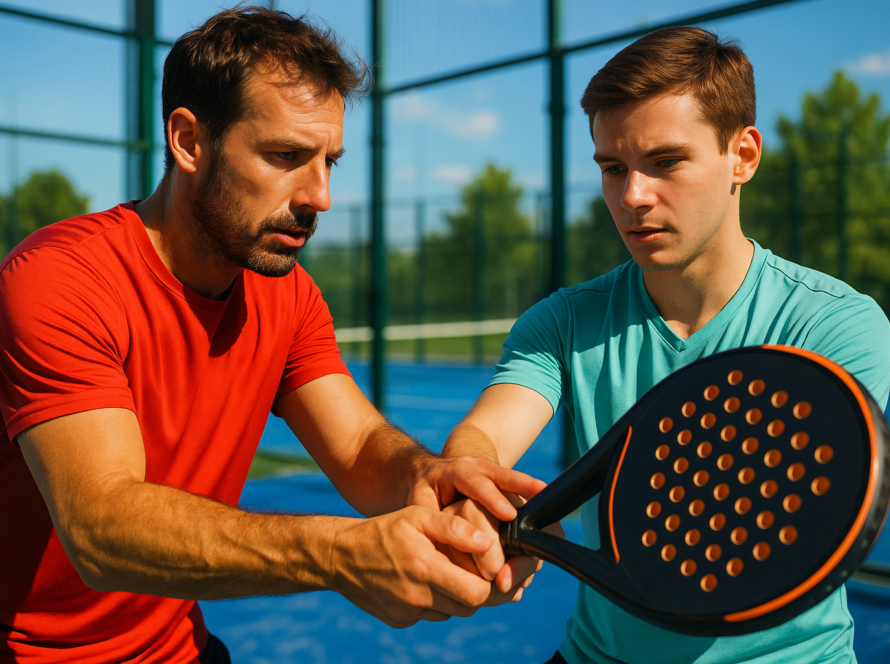
Before we talk about technique, let us start with the foundation — your grip. For the padel smash, you should use the continental grip (also known as the hammer grip). This is the same grip used for serves in tennis and is the most versatile overhead grip in padel.
How to Find the Continental Grip
- Hold the racket out in front of you with the edge facing down, as if you were hammering a nail
- Place your base knuckle (index finger) on the second bevel of the racket handle
- Your thumb and index finger should form a V-shape that sits on top of the handle
- The grip should feel natural — not too tight, not too loose
A common mistake among beginners is using an Eastern forehand grip (the frying pan grip) for smashes. While this can generate power, it severely limits your ability to add slice, direct the ball, and transition between different overhead shots like the bandeja and vibora.
Grip Pressure
Keep your grip pressure at around 5 out of 10 during the preparation phase. As you make contact with the ball, briefly squeeze to about 7 or 8 out of 10, then relax again. This allows for wrist flexibility and snap, which are crucial for generating spin and power. For more detail on grips, check out our Padel Racket Grip Guide.
Stance and Body Position
Your body position before the smash is just as important as the swing itself. Good preparation gives you balance, power, and options.
The Ready Position
- Turn sideways — as soon as you identify the lob, turn your body so your non-racket shoulder faces the net
- Point with your free hand — extend your non-racket arm upward, tracking the ball. This helps with timing and balance
- Racket back early — bring your racket up behind your head, elbow high, creating a throwing position
- Small adjustment steps — use quick, small steps to position yourself directly under or slightly behind the ball
- Weight on back foot — load your weight onto your back foot, ready to transfer forward as you swing
Positioning Under the Ball
One of the biggest differences between a padel smash and a tennis smash is positioning. In padel, you generally want to make contact with the ball slightly in front of your body and at the highest comfortable point you can reach. This gives you maximum downward angle, better control over direction, and the ability to drive the ball into the ground before it reaches the back wall.
If you let the ball get behind you, you lose power, angle, and control — and the ball is far more likely to sit up off the back wall for your opponents.
The Swing: Step by Step
Phase 1: Preparation
As the lob goes up, turn sideways immediately. Bring your racket up into the trophy position — elbow high, racket head behind your head, non-racket arm pointing at the ball. Your feet should be shoulder-width apart with your weight loaded on the back foot.
Phase 2: The Forward Swing
Begin transferring your weight from your back foot to your front foot. Your hips and shoulders should rotate together, generating power from the ground up — legs, core, shoulder, arm, wrist. Think of it as a throwing motion, like launching a ball over a high wall.
Phase 3: Contact Point
Strike the ball at the highest comfortable point, slightly in front of your body. Your arm should be nearly fully extended (with a slight bend at the elbow). At the moment of contact, snap your wrist forward to generate topspin and direct the ball downward.
Phase 4: Follow Through
After contact, your racket should follow through naturally across your body, finishing on the opposite side. Do not try to stop the racket abruptly — a full follow-through ensures power and reduces the risk of injury.
Types of Padel Smash
Not every smash situation calls for the same shot. Understanding when to use each type is what separates good players from great ones. For an even deeper dive into smash types, see our Complete Padel Smash Guide.
1. The Flat Smash
The flat smash is the most powerful version — hit with minimal spin, maximum pace. Use it when you are in a strong position, well balanced and under the ball, the lob is short and high giving you a clear angle, or you want to hit the ball out of the court (por tres). Aim for the side wall or the area between your opponents. The flat smash is high-risk, high-reward.
2. The Topspin Smash
Adding topspin to your smash makes the ball dip faster after bouncing, making it harder for opponents to retrieve. Use a more pronounced wrist snap at contact and brush up and over the ball. This is the safest power smash because topspin brings the ball down quickly.
3. The Slice Smash
A slice smash is hit with underspin, causing the ball to skid low after bouncing. It is particularly effective when directed at the side wall, as the spin makes the ball die or kick unpredictably. This is a transitional shot between a full smash and a bandeja.
4. The Por Tres (Out-of-Court Smash)
The ultimate crowd-pleaser. The por tres smash is hit with such power and angle that the ball bounces once on the court and then flies over the back wall or through the side fence gate. This is an outright winner. To execute it, you need a high contact point, a steep downward angle, and significant pace.
Common Smash Mistakes and How to Fix Them
Mistake 1: Hitting Too Flat Into the Back Wall
If your smash consistently bounces off the back wall and sets up your opponents, you are probably hitting too flat and too deep. Fix: Aim for the ball to bounce closer to the service line, or add topspin to make it dip before reaching the wall.
Mistake 2: Poor Footwork
Many players do not move their feet enough before smashing, leading to off-balance, weak shots. Fix: Use small, quick adjustment steps. Always try to get slightly behind the ball so you can move forward into the shot.
Mistake 3: Dropping the Non-Racket Arm
Dropping your free arm too early ruins your balance and timing. Fix: Keep your non-racket arm up, pointing at the ball, until the last moment before you swing.
Mistake 4: All Arm, No Body
Swinging with just your arm generates far less power than using your whole body. Fix: Focus on hip and shoulder rotation. The power chain goes: legs, hips, shoulders, arm, wrist.
Mistake 5: Wrong Shot Selection
Trying to hit a flat smash winner from a deep, high lob often backfires. Fix: If the lob pushes you back, consider a bandeja or vibora instead. Save the power smash for when you are well-positioned.
Smash Drills to Improve Your Technique
Drill 1: Wall Target Practice
Stand at the net and have a partner feed high lobs. Place targets (cones or markers) on the court — one near each side wall, one in the middle. Practice directing your smash to each target zone. Focus on accuracy over power initially.
Drill 2: The Bounce and Smash
Feed yourself by throwing the ball high in the air. Let it bounce once, then smash it. This helps you work on timing, footwork, and contact point without the pressure of a rally.
Drill 3: Continuous Overhead Rally
One pair plays only lobs, the other pair plays only overheads (smashes, bandejas, viboras). Play points out. This simulates real match scenarios and forces you to choose the right overhead shot under pressure.
Drill 4: The Power Test
Practice hitting smashes that bounce once on the court and fly over the back wall. Count how many out of 10 you can get por tres. This develops your ability to generate pace and angle for winner smashes.
Drill 5: Recovery Smash
Start at the back of the court. A partner feeds a short lob that lands near the net. Sprint forward and hit an overhead. This drill improves your movement, timing under pressure, and decision-making.
Tactical Considerations
Where to Aim Your Smash
- Down the middle — creates confusion between opponents about who should take the ball
- At the weaker player — exploit the weakest link in the opposition
- Into the side wall — with spin, the ball kicks unpredictably after hitting the glass
- At the feet — force opponents to hit from a low, uncomfortable position
- Por tres — when you have the angle and power for an outright winner
When NOT to Smash
Smart padel players know that not every overhead should be smashed at full power. Consider a bandeja or vibora when the lob is deep and pushes you behind the service line, you are off-balance or out of position, your opponents are well-positioned and expecting the smash, or the ball has dropped too low for a comfortable contact point.
Equipment Tips for Better Smashing
Your choice of racket can significantly impact your smashing ability. For maximum smash power, consider a diamond-shaped racket with a high balance point — these are designed to generate power on overhead shots. However, they require good technique. If you are still developing your smash, a teardrop or round racket may be more forgiving. Check our Best Padel Rackets 2026 guide for recommendations.
Good padel shoes are also essential — you need grip and stability to position yourself properly under the ball. On slippery indoor courts especially, poor footwear can ruin your smash preparation.
Final Thoughts
The perfect padel smash is a combination of solid technique, smart positioning, good footwork, and tactical awareness. It is not just about hitting the ball as hard as you can — it is about choosing the right shot at the right time and executing it with precision.
Start by mastering the fundamentals: continental grip, sideways stance, high contact point, and full follow-through. Then work on adding variety — topspin, slice, and the por tres. Finally, develop your tactical awareness so you know when to unleash a full smash and when to dial it back with a bandeja.
Get out on court, work through the drills, and watch your smash transform from a hopeful swing to a genuine weapon. Your opponents will thank you — or rather, they will not.
Compare prices and read customer reviews